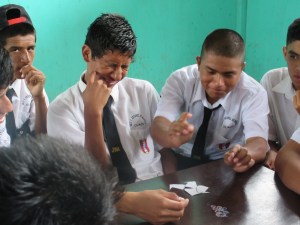
 Take a minute to think about your high school experience.
Were you popular? The nerd? A jock? Did you barely participate or were you involved in every club?
Whether you took advantage of the opportunities or not, you likely had the choice to play a sport, join a club, or even advance your studies.
In rural Peru, if those options exist, they are very limited. It’s more than likely that every school has a Municipio Escolar (Student Council), Brigadiers (health and environment representatives, and classroom monitors); but outside of those, it’s hard to find organized sports, youth groups, or even study hours. There are a number of factors contributing to this—some students live an hour away, other students have to work or help around the house. Teachers are overworked, some feel underpaid. And even more so, some teachers commute 2 hours one way to get to their job daily.
Given the limited opportunities students have to feel involved in their school, and subsequently their communities, it wasn’t a surprise to me that, of 211 students surveyed, only 42% responded that they felt the adults in the community valued the youth. Based on that and other information I had gathered while writing my community diagnostic, I felt there was a great opportunity to get the youth involved in a positive, productive manner.
My thoughts raced through my own high school experience while I brainstormed activities. I had been involved in various sports, theatrical productions, and volunteer projects. Bingo- volunteering. Knowing that the students had limited time outside of class, I began thinking of ways to include volunteering in a classroom setting—light bulb again – a service learning project.
About this time, all of the youth volunteers from Peru 23 came together for our Early In-Service Training. Others had also been contemplating taking on a similar project, and so the ideas flowed. That’s also when serendipity stepped in.
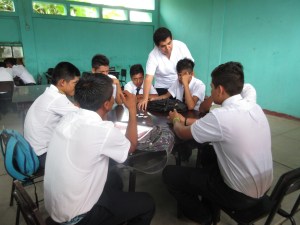 One of Peace Corps Peru’s focuses is Gender Equity. During our EIST, a partner agency, Mujeres y Niñas al Frente Peru (Women and Girls Lead Global) came to screen a documentary, “The Revolutionary Optimists.” Our recently formed partnership with them allows volunteers access to several documentaries to screen to our communities. The documentary, about children who took it upon themselves to participate and better their communities, was moving and motivational—and got one of the volunteers really thinking. She looked up the documentary and stumbled upon a series of lessons for a project called “Map Your World,” which basically was an already created program like what we had all been brainstorming. We’ve since added a few classes on either end of the program, really delving into “What is a leader?” on the front end and public speaking on the back end.
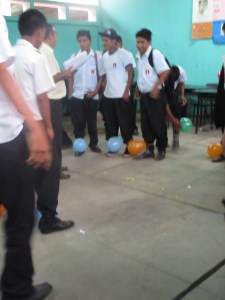 Excitedly, I presented “Map Your World,” with our modifications, to my main socio at the high school and he immediately was on board. We agreed to implement it during his two sections of tutoria and during a third section of another teacher’s. During our second week of classes, a psychology student, who interns at all of the schools in town, teamed up with us to help facilitate charlas as well.
We just wrapped up our third week of lessons where we discussed critical thinking skills. Our previous two weeks were focused on identifying leaders and their characteristics and self-esteem. We teach actively, playing games and having open discussions about the topics. Each week, the classes surprise me with their participation and engagement. I even had one student give me two oranges!
I’m excited to see how the rest of the school year turns out, and what projects the students take on to better their communities. I’ll be sure to keep updating the blog as we chug along.
 Brittany McGee