 “In through the nose, out through the mouth. In through the nose, out through the mouth,” I repeated in my head. I was at kilometer 14, the course was at a slight incline and I was struggling to keep my breathing steady. I was running much faster than I had anticipated, a side effect of the adrenaline rush I was experiencing. Aside from my breathing, I felt great. I could feel myself using different muscle groups to maintain my pace, and my head was very much in the race.
By kilometer 19, I really wondered why I didn’t train for the full marathon.
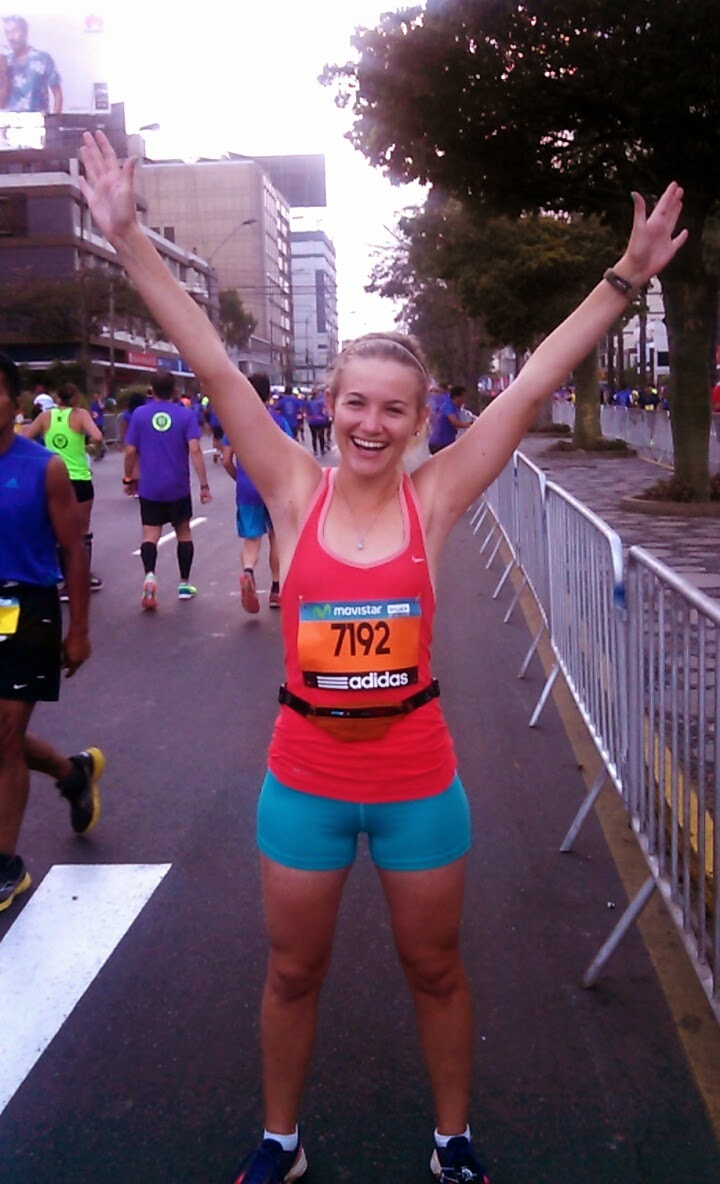
And as I crossed the finish line, 6 minutes and 45 seconds faster than my goal time, I felt a rush of emotions pouring over me.
As long as I can remember, I’ve always turned to running as a way to manage life’s stressors. But, it wasn’t until 4 years ago that running truly became a part of my DNA.
As an angsty teenager, I often would go for a run with my portable CD player (imagine that large thing clunking around) and wind up at a playground or stream to sit and think. In college, running became a means to achieve fitness goals and shed the Freshman 15.
My first year out of college, running became so much more. As I trained for my first half marathon in 2012, running became a part of who I was. That’s not to say I have consistently run for the past three and a half years; like any other relationship, I’ve had my ups and downs with running. I’ve had problems with weak ankles, tight IT bands, joints hurting. I’ve decided it was just too cold or way too hot to run. And I’ve had days where I just flat out felt lazy.
 But time after time, I keep returning to running.
I was high off of my first full marathon when I interviewed for the Peace Corps in 2013. Running a sub 4 hours race, I had blown everyone’s expectations of how fast I would finish, including my own. After having achieved what I didn’t think was possible, I was eager to keep running- to push myself to do even better.
But that high was quickly subdued as the Dallas Peace Corps Recruiter asked me how I manage stress.
“I like to write, sometimes talk it out. But, usually, I turn to running.”
He responded that first two were good options, but that I might not be able to run in whatever country I serve and I had to be okay with that. After the interview I mused over the idea that as a woman, living in a remote location, I likely would not be able to run for cultural and safety reasons. As I accepted this, I didn’t think it would truly bother me.
 Despite my expectations, exactly 11.5 months after moving to Peru, here I was, running the Lima Half Marathon. I made the commitment to run early on, mentally preparing myself as soon as I had heard of the event a month before arriving in Peru. The Lima Marathon and Half Marathon was something volunteers looked forward to, and many found themselves able to train in site.
While I was committed, training started off slow. I began running in site in September. Short distances. Slow times. Regardless, the people in my community watched and cheered me on as I ran through the small town.
“Run faster!”
“Run, gringa, run!”
But, my training was short lived as I eventually developed allergies and had zero energy because I was lacking nutrients in my diet. It didn’t help that I also had gained ten pounds and found it difficult to run for more than 10 minutes.
After months of being down on myself for not running and gaining weight, I decided I was tired of feeling miserable. I shook myself out of my slump and got my head back in the game. I started running with my site mate along the old Pan American Highway—where we had kilometer markers to measure our distance. Slowly but surely, running became a consistent again.
The more I ran, the more I felt in-tune with myself. While I didn’t realize how important running was to me when I interviewed for Peace Corps, training for the Lima Half Marathon really reinforced how deeply I do enjoy the activity and how it in many ways has become a part of who I am.
As I continued training, I faced new challenges. Ferocious dogs being one of them. Men yelling obscene things as they passed in their motos or trucks was another. There were times where I would have to literally stop running, pick up a rock, and walk 200 meters just to avoid being attacked by a dog. There were other times where I would yell at men, driving slowly next to me, to leave me alone. At the end of both those runs, I would come back to my room feeling not only physically drained, but emotionally as well.
But I kept at it, with a goal of running the 13.1 miles in 2 hours in mind. And people in town took notice. I would randomly meet people who saw me running and were impressed with my dedication. My running became a conversation starter. A way for locals to connect with me. Part of my identity in the community.
As I crossed the finish line on May 17, I felt elated, exhilarated, and above all empowered. Yes, I was happy I beat my goal time, but I was even more excited that I had finished. That, despite various obstacles, I was able to just run. That I was able to be me.

 Brittany McGee
Glad to hear it and here you were worried you wouldn’t even finish in 2 hours. Hopefully, I will be training soon for my first marathon so thanks for the motivation.