 As I stood in the shade, talking to my site mate’s host sister, I asked her about Peruvian customs related to death, funerals, etc. I was astonished that the funeral was happening so quickly. I told her that in the States, we usually wait a few days, sometimes a week. I couldn’t think of an instance of the funeral being the day after a person had passed.
But that was the case for Vilma. And it’s the case for most Peruvians who pass away.
I wasn’t planning on going to a funeral Sunday; in fact, I didn’t even know Vilma had passed away until a few hours beforehand. The news caught me completely off-guard as I had already been mourning for Julio. They passed the same day; actually, four people in Olmos died that Saturday. Somehow I knew two of them.
Vilma was the police officer who helped me muddle my way through the swearing-in ceremony in the caserio of Cerro de Cascajal in April. She was so kind and gracious; I don’t know if she realized how grateful I was for her help. She and I kept running into each other at other ceremonies and had exchanged numbers, promising to get together soon. We had talked about taking dance lessons from a friend of hers and going to another officer’s nearby fish farm.
But, it was all talk. It hadn’t come to fruition yet. And, now there won’t be a chance for it to. She and another police officer were on their way to a training Saturday, when at 5:30 in the morning they crashed into a truck carrying rice. She died on the scene. She was only 28.
The sun was strong, beating down on the sea of people. I made my way through the crowd, watching as people paid their respects to the fallen police officer. We were in front of the police station and people had lined up one by one to greet Vilma’s parents and walk by her casket. I found another familiar face watching the ceremony, a retired professor, the man who told me that Vilma had passed. I paused to greet Professor Alberto, who then introduced me to one of Vilma’s uncles.
I had thought that morning about writing a note for her family and leaving it at the police station, but here I was able to tell one of her family members that she helped me out a lot and was a genuinely good person. He seemed appreciative, albeit surprised that his niece knew a Gringa.
I admired the work that Vilma did. She was the only woman who worked in the police station in town. She worked 6 days a week, relentlessly. She was in charge of investigating domestic violence, something that there unfortunately is a high occurrence of in Olmos—and most of Peru.
The time had finally come to move Vilma’s body, in her elaborate, white casket, to the church for Mass, which would be followed by a burial at the cemetery. While there was a hearse, we followed tradition.
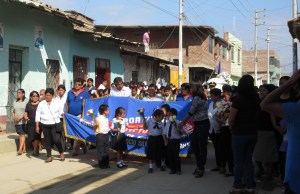 Pallbearers carried her casket from the police station to the church, surrounded by at least 100 people. At the very front, there were two different groups carrying banners—one made of women from the Peruvian Police and the other consisting of children from a community sports group that Vilma was active in as a child. Behind them, there were “flower children” throwing petals as we walked through the town. Two of them had caught my eye earlier, as they were wearing white dresses—again, tradition. Following the casket was the band. And wandering around were official videographers and photographers.
The crowd snaked its way through the town. What is normally a 2-minute walk took about 20 minutes. As we walked, p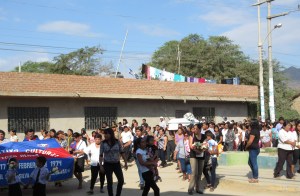 eople stopped what they were doing to come out of the tiendas or their houses to watch. People called out to others they knew, expressing sentiments of condolences. Older ladies made the sign of the cross as the casket passed.
I’ve been in site 11 months and attended a variety of events, but this was the first time I had felt an overwhelming sense of community. While the circumstances were tragic, I was proud of the town and how they came together to show their support to Vilma’s family. I hope that Vilma’s family took comfort in the solidarity of Olmos as I did. 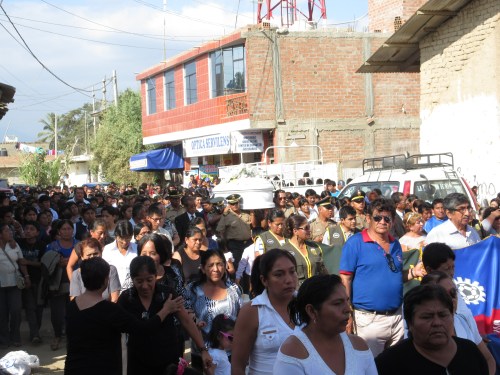
 Brittany McGee