 Imagine that you’re 16 again. What immediately pops into your head?
Friends. High school classes. Family. Extra-curricular activities. Getting your driver’s license.
Maybe you’ve considered your future. You probably know whether or not you want to go to college. You might even know what you want to major in. At least, for the day. Because at 16, your ideas might change on a monthly, weekly or even daily basis. You have your whole future ahead of you, and you’re not under any pressure to decide what you want to do for the rest of your life right now. You’ll take the SAT or ACT in another year, continue to keep your grades up, get into a university and you might even change majors three or four times once you’re there.
At least, that’s how it is for many 16-year-olds in the US.
In Peru, it’s a different story.
To a 16-year-old, the world is different. Opportunity doesn’t come knocking on the door as often. At 16, the students are in their final year of secondary school. Some have part-time jobs to help support their families, others help out around the house – cooking, cleaning, caring for their siblings. Most know that furthering their education is important, but several write it off because of the cost. Or because they don’t know what they want to do.
The Peruvian government and private institutions do as much as possible to offset the costs, offering scholarships and grants.
But, the latter issue is much more systemic. Each superior education institution has its own costly admissions tests and typically they don’t enroll students under “undeclared majors.” Students apply to a specific career and are in that major for 3 to 5 years depending on technical institute or university.
At 16, Peruvian teenagers are forced to make a GINORMOUS decision. A decision that affects their entire life-course.
This is why vocational orientation is so important to the Peruvian curriculum, and why I spent so much time working with teachers on implementing activities related to personal and career discovery and development.
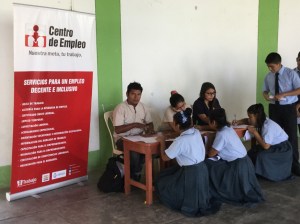
It’s also why the Olmos College and Career Fair has become a staple within the community. For the 5th year in a row, the fair brought in institutions, universities and organizations from the regional capital and drew in students from all over the district. Working with the Defense of Children and Adolescents office, my site mate and I coordinated the event, held during the town’s anniversary celebration.
200 students spent the morning chatting with representatives from 12 post-secondary schools and agencies, learning about new career paths and opportunities.


It’s unusual for a Peace Corps volunteer to see immediate impact from community projects, especially when it comes to Youth Development. This year’s fair provided a couple of exceptions. During the fair, an older teenager enlisted in the military. While he had probably considered joining prior to the fair, he had the opportunity to sign up that day. And a week after the fair, a representative from a technical institution made the 2-hour trip to Olmos to visit the head of the Defense of Children and Adolescent office. He congratulated her on a successful event and informed her that the mother of a student had called their admissions office wanting to enroll her daughter.
For those two adolescents, doors were opened that day and their life’s journey was changed. At a young age, they took steps towards a brighter future. One that hopefully holds more opportunities.
 Brittany McGee