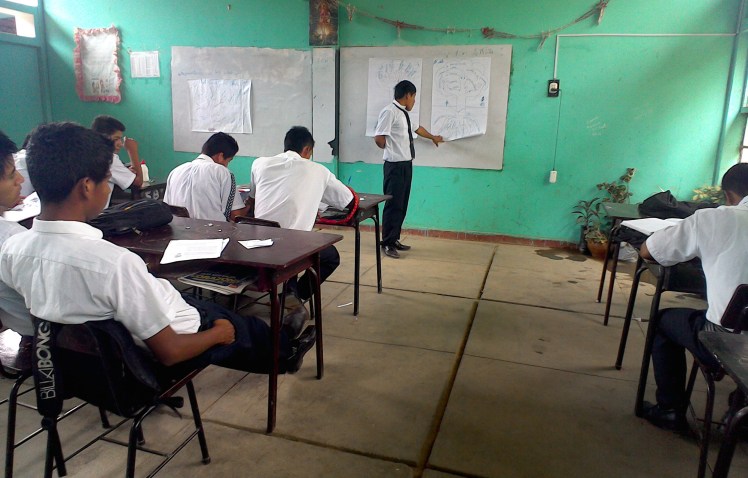
Take a minute to think about your community. Imagine the streets, the buildings, the people. Are there children running around? What about animals? What do you see, hear, smell, feel? Do you feel safe? What about at night? Does your community change?
Those are just some of the questions I asked 73 students participating in the “Map Your World” project. As they somewhat reluctantly closed their eyes to picture Olmos, most of them were quick to shout out their answers rather than quietly and individually reflect. Some of their answers were comical, as to be expected in any classroom full of teenage boys; other answers were full of insight.
We took the activity one step farther and they begrudgingly drew maps of Olmos. A handful of them actually could imagine how the streets were aligned, others relied on input from their classmates. A few creative types drew what Olmos signified to them.
Next, each of the three classes worked to identify strengths, weaknesses, opportunities and threats to the district; most business types know this as completing a SWOT analysis. Among the three classes, the strengths and opportunities varied, but the weaknesses and threats more or less were repeated over, and over.
Contamination, deforestation, illnesses, drugs, alcohol, general delinquency, corruption.
BINGO.
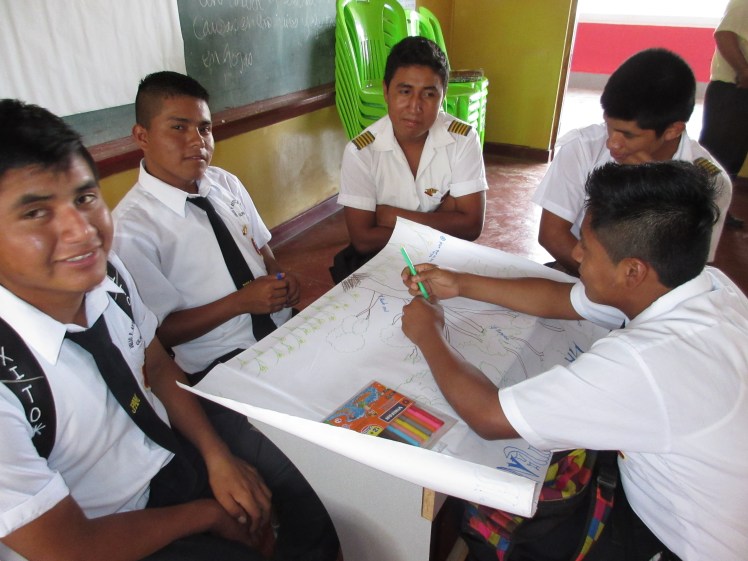
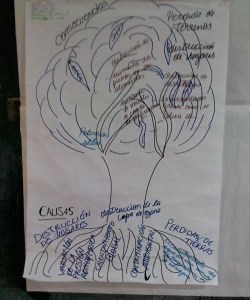 We had established the areas we could focus on in order to improve Olmos. But we weren’t quite ready to do anything about it just yet. In each class, the students formed 3 or 4 groups of 5-7 members. Using a tree, we practiced illustrating cause and effects of a general problem; then each group created a tree to address its own problem. Causes were written in the roots, effects in the branches.
The cause and effect trees easily took double the amount of time anticipated. The students really got involved in this portion—commenting that traditions led to deforestation and habits passed down from each generation led to contamination.
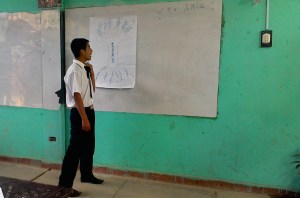 After identifying the cause and effects, each group envisioned a future, five years from now in which they had worked to eliminate the problem. Given all the resources in the world, they thought up projects that they would have implemented if they had the time, money, and human power behind it. Some of them were more creative, others more simple. The group working on HIV/AIDS prevention wanted to provide free HIV screenings, give medications to all people with HIV/AIDS for free, find a cure for HIV/AIDS and host educational chats to prevent the spread. The group working to address contamination wanted to better all factories so they wouldn’t cause pollution, and the group working on deforestation simply wanted to plant more trees and create penalties for cutting them down.
Using how they imagined the future, the groups created vision and mission statements and set goals. If you’ve ever tried creating vision and mission statements, you know this isn’t an easy task. In my past life, aka pre-Peace Corps, this was something I regularly did on my own, with my marketing team, franchisees, etc. The students really surprised and wowed me. The group working on El Niño preparedness eloquently wrote:
Vision: “To save more lives, to not have to grieve and to live safer conscious that aid is present in any emergency.”
Mission: “To be better prepared for the eventual phenomenon El Niño so that we will not have to suffer the loss of both material and human.”
The end of the school year really snuck up on us, so we won’t have a chance to finish the project. The final step that the groups will be completing is to write a work plan, for now an imaginary project. They’ll have to outline specific steps that they would take to complete a project that addresses their specific issue.
Despite not finishing the “Map Your World” program as planned, I can see the positive affects it has had on the teenagers. Each class grew a little bit more interested in what we were doing, started taking the activities a little more seriously. They began opening up and talking about other problems within the community and we talked about small things they could do to better them. They started seeing the big picture, caring about the consequences of their actions. Most of them grew personally as well. While we didn’t get to complete a project out in the community, I’m happy just knowing that they learned something this year that hopefully they’ll take with them once they leave high school.
After all, they are the future agents of change in their community.
 Brittany McGee
Great lesson for everyone!
Bravo! This is a great lesson for everyone, not just your students.